
Why IIP Academy Offers One of the Best Photography Courses in India (In Collaboration with Bareilly International University)

Choosing the right photography course after 12th can shape your entire creative career. With hundreds of institutes claiming to teach photography, finding one that combines artistic depth, university recognition, industry relevance, and genuine placement outcomes is no small task. IIP Academy, now offering UGC-approved degree programmes in collaboration with Bareilly International University under the Faculty of Fine Arts, has built a reputation over 16 years as one of the best photography institutes in India - and there are concrete reasons why.
A Legacy That Speaks Through Numbers
When families research a photography degree course in India, the first question is usually about credibility. Photography education in India is still a relatively young field, and many institutes have appeared in the last few years without any meaningful track record. IIP Academy is different. Founded in 2010 by Rajesh Goyal - a photographer, branding expert, and educator with over 30 years of experience across advertising, media, and cultural documentation - the academy was among the first institutions in India to build a structured, professional curriculum around photography education. Over 33,000 students from more than 40 countries have trained at IIP Academy since then, and the institute maintains a 100% placement record. These are not marketing slogans placed on a banner. They are the result of a teaching system refined across 16 years, thousands of graduates, and hundreds of industry partnerships.
University-Recognised Degrees, Not Just Certificates
One of the most important developments for anyone searching for the best photography course in India is the growing availability of formal degree programmes. Until recently, most photography training in India existed outside the university system - short-term certificate courses, weekend workshops, or diploma programmes from private institutes. IIP Academy's collaboration with Bareilly International University under the Faculty of Fine Arts changes that equation entirely. Students can now pursue a Bachelor of Fine Arts in Photography, a Master of Fine Arts in Photography, or a Diploma in Photography - all through a UGC-approved university. This means the qualification carries genuine academic weight. It is recognised by employers, accepted for higher education applications, and valid for education loan approvals from banks. For students and parents evaluating a photography course after 12th, this university recognition removes one of the biggest concerns about choosing photography as a profession: the fear that it will not be treated as a real qualification.
The programme structure follows a carefully designed academic ladder. A student can enter at the Certificate level after completing one year, progress to a Diploma after two years, earn a BFA after three years, continue to a BFA Honours in the fourth year, and complete an MFA in one or two additional years depending on their prior qualification. This tiered pathway means students are never locked into a single commitment. They can enter the system, see results, and decide how far they want to go - all within one continuous academic framework aligned with the National Education Policy 2020.
A Teaching Philosophy Built on Mentorship, Not Lectures
What separates a good photography institute from a great one is not just the syllabus - it is how that syllabus is taught. IIP Academy follows what it calls the Guru-Shishya model of mentorship. This is not a marketing phrase borrowed loosely from tradition. It describes a genuine pedagogical approach where students work in small groups with experienced faculty who guide them individually through projects, critiques, creative development, and professional preparation. The ratio of theory to practice is deliberately skewed towards doing. From their very first week, students work on real photography assignments - not hypothetical exercises from a textbook.
This practice-based learning philosophy extends into every part of the curriculum. Students document cultural festivals, shoot for corporate brands, work on editorial assignments, participate in exhibitions, and build portfolios that reflect actual professional experience rather than classroom simulations. The academy's students have worked on projects involving Kumbh Mela documentation, national youth events, international cultural exchange programmes, and assignments for organisations including Google, National Geographic, Mercedes, Harley Davidson, and The Times of India. These are not names dropped for effect - they represent genuine industry exposure integrated into the learning journey.
Infrastructure That Matches Professional Standards
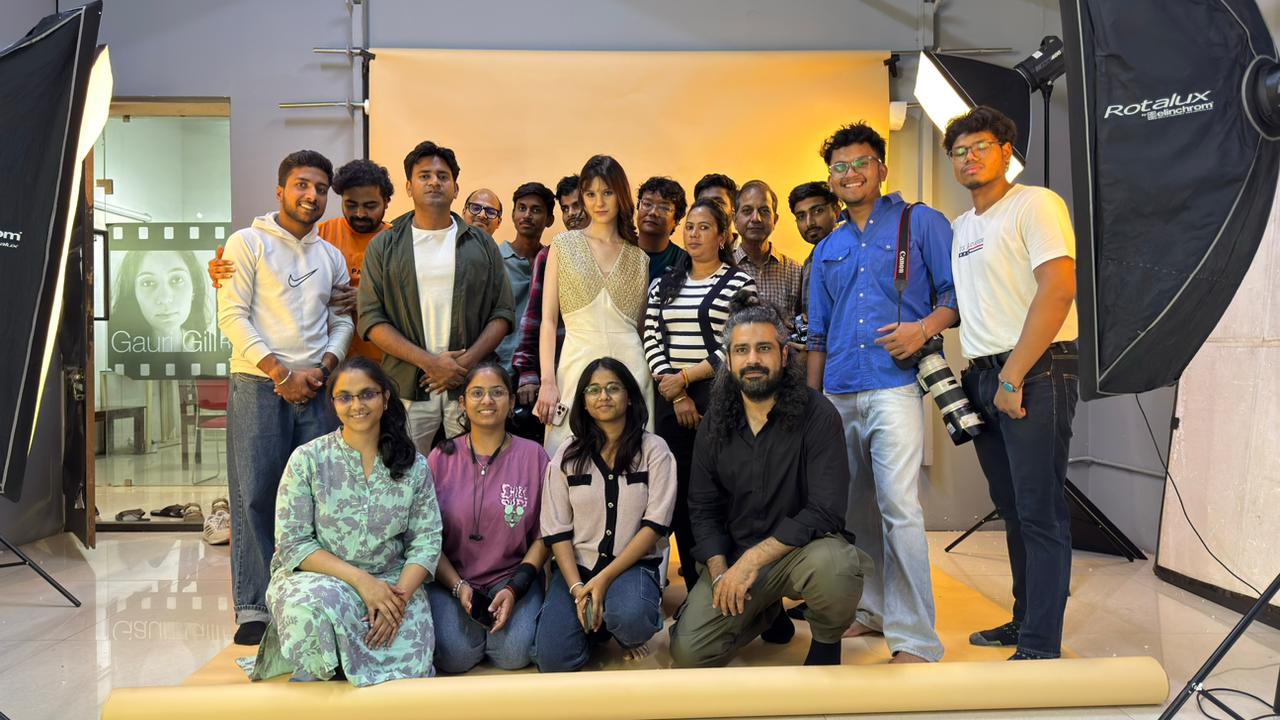
A photography education is only as good as the facilities available to students. IIP Academy's Noida campus has been designed as a working creative environment, not just a classroom block. The campus includes professional photography studios equipped for various genres, digital editing labs with industry-standard software, an analog darkroom for students interested in film-based processes, an art studio, a library and research centre, a theatre and exhibition gallery, and dedicated collaboration spaces where students can work together on projects. Mentor consultation rooms provide private space for one-on-one sessions between faculty and students. This infrastructure matters because photography is a craft that demands hands-on repetition, experimentation, and access to professional-grade tools. You cannot learn studio lighting from a PowerPoint slide, and you cannot develop an eye for post-production without spending hours in an editing suite.
The Student Journey: From Artistic Thinking to Career Readiness
IIP Academy structures its programmes around a four-stage transformation framework that every student moves through over the course of their studies. The first stage focuses on artistic thinking - developing a personal visual language, understanding composition, light, colour, and the history of photographic practice. The second stage builds confidence through repeated practice, peer critique, and exposure to real-world assignments. The third stage deepens cultural understanding - students study the context in which art exists, engage with Indian heritage and global visual culture, and learn to create work that carries meaning beyond technical competence. The fourth stage is career readiness - portfolio development, professional branding, client management, entrepreneurship skills, and direct placement support.
This framework is not a theoretical model printed in a brochure. It is the actual sequence of learning experiences that students go through, and it explains why IIP graduates tend to enter the industry with a level of preparedness that goes beyond technical skill. They understand how to think, how to present their work, how to communicate with clients, and how to sustain a career in a competitive creative field.
Why the BIU Collaboration Matters for Aspiring Photographers
For students specifically searching for a photography degree course in India, the collaboration between IIP Academy and Bareilly International University deserves close attention. The Faculty of Fine Arts at BIU offers five programmes: MFA in Photography, BFA in Photography, Diploma in Photography, BFA in Film Making, and Diploma in Cinematography. Each of these programmes combines IIP Academy's 16-year pedagogy and industry network with the academic structure and degree-granting authority of a UGC-approved university. The result is an education that is simultaneously practical and formally recognised - something that has historically been difficult to find in Indian photography education.
The programmes are also designed with flexibility in mind. Students who may not be ready for a three-year BFA commitment can begin with the Diploma and upgrade later. Students who complete a BFA can continue directly into the MFA without switching institutions or starting over. And because the curriculum is aligned with NEP 2020, it incorporates the kind of interdisciplinary, research-oriented, and credit-based academic structure that modern employers and postgraduate institutions expect.
Placement and Career Outcomes
The 100% placement record is perhaps the single most important statistic for families evaluating whether photography is a viable career. IIP Academy maintains this record not through a placement cell that sends out bulk emails, but through a system of industry partnerships, portfolio reviews, and professional mentorship that prepares students for specific career paths. Graduates work across wedding and event photography, fashion and editorial, advertising and commercial photography, photojournalism, documentary filmmaking, product photography, and fine art practice. Many have built independent studios and freelance careers. Others work with media houses, advertising agencies, e-commerce platforms, and cultural organisations.
For students choosing a photography course after 12th, this placement track record answers the most practical question any parent will ask: Will my child get a job? At IIP Academy, the answer is backed by 16 years of evidence.
Research, Culture, and a Bigger Vision
Beyond career training, IIP Academy is also a research institution. The IIP Foundation's Research and Archiving Department has conducted more than 25 projects related to Indology, Indian heritage, crafts, and cultural documentation. Students participate in these research initiatives as part of their academic experience, which means they graduate with exposure to cultural scholarship alongside technical photography skills. The academy has also been involved in international cultural exchange programmes with countries including China, Serbia, and the SAARC region. This commitment to research and cultural dialogue sets IIP Academy apart from institutes that treat photography purely as a commercial skill.
The Bottom Line
If you are looking for the best photography course in India - one that offers university-recognised degrees, a proven 16-year track record, world-class infrastructure, genuine industry exposure, a mentorship-driven teaching philosophy, and a 100% placement record - IIP Academy's programmes under the Faculty of Fine Arts at Bareilly International University deserve serious consideration. Whether you are a Class 12 student exploring your options, a working professional looking to formalise your skills, or a parent researching the safest academic investment in a creative career, the evidence points clearly in one direction. Over 33,000 students from 40+ countries have already made that choice. The question is whether you are ready to make yours.
