
From a Ranchi to a Life Behind the Lens: Siddharth Malla's Journey of Passion, Courage and Purpose

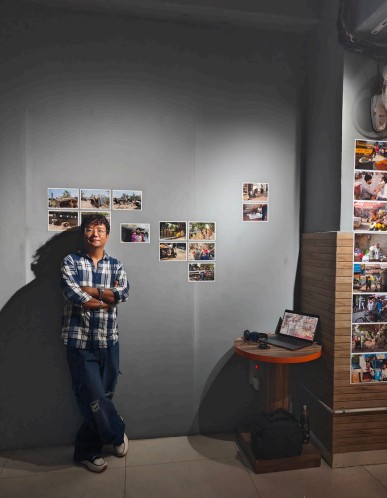
How Let's Talk Photography with Rajesh Goyal helped an aspiring photographer discover the Indian Institute of Photography and find the courage to leave a secure career to follow his true calling.
Talent can emerge from anywhere. It does not recognise geographical boundaries, financial limitations or conventional definitions of success. Sometimes, all it needs is an opportunity to be discovered, a mentor who can provide direction and an institution willing to believe in the learner.
The journey of Siddharth Malla, a student of the Dual Diploma in Photography and Cinematography at the Indian Institute of Photography, is a powerful example of this belief.
Siddharth did not begin his journey in a metropolitan city surrounded by art schools, professional studios and creative networks. He comes from a small, remote village in Nepal, where opportunities were limited and the path towards a creative profession appeared distant. His early life taught him that dreams are rarely achieved through desire alone they demand sacrifice, discipline and perseverance.
During his childhood, Siddharth moved to Jamshedpur, Jharkhand, in search of better education and a more secure future. By the time he reached Class 8, he understood that continuing his studies would require him to take responsibility for his own expenses. He sold newspapers in the mornings and taught younger students after school. Instead of allowing difficult circumstances to discourage him, he transformed them into lessons in self-reliance, gratitude and determination.
These early experiences shaped the disciplined and sincere individual he would later become.
An Engineer Who Began to See Differently
In 2008, Siddharth cleared the Government Engineering Entrance Examination in Tamil Nadu. It was a significant milestone, but it also meant beginning again in an unfamiliar environment. He continued supporting his education through part-time work and tuition while completing his engineering degree.
After graduation, Siddharth joined Siemens as an Automation Engineer in a project team. The corporate environment introduced him to professionalism, planning, teamwork and accountability. It appeared that he had finally achieved the stability for which he had worked so hard.
Yet, another journey was quietly beginning.
As part of his professional responsibilities, Siddharth was required to document the progress of construction projects. He photographed industrial sites, architectural structures, machinery and construction details. Initially, the camera was simply a tool for technical documentation. Gradually, however, Siddharth began observing more than the project in front of him.
He noticed the rhythm of lines, the balance of structures, the relationship between light and shadow and the unexpected beauty hidden inside industrial spaces. Even with a small point-and-shoot camera, he discovered that photography could transform ordinary surroundings into meaningful visual experiences.
This was not merely an interest in operating a camera. It was the beginning of a new way of seeing.
When Passion Begins Asking Difficult Questions
For many aspiring artists, the greatest struggle is not discovering their passion. It is finding the courage to take it seriously.
Siddharth had built a respectable career through years of hard work. Leaving it behind was neither easy nor immediate. Like many working professionals who carry an unfulfilled creative aspiration, he had to confront difficult questions.
Was photography only a hobby, or could it become his life's work? Was it practical to leave a secure corporate career? Did he possess the artistic ability required to become a professional photographer? Would structured education make a meaningful difference? Could someone who had not grown up in an artistic environment find a place in the creative industry?
These questions stayed with him.
By 2023, Siddharth decided that he could no longer ignore the calling. He left the security of his corporate career and joined FOTO ME, a wedding photography studio in Ranchi, to gain practical industry experience.
His engineering and corporate background helped him contribute to studio management and improve daily operational systems. He also photographed weddings and events. The experience brought him closer to professional photography, but it simultaneously made him aware of the gaps in his learning.
He realised that taking technically acceptable photographs was not enough. He wanted to understand why an image worked. He wanted to study light, composition, visual language, aesthetics, storytelling and the responsibility that comes with representing people and their experiences.
What he needed was not another collection of camera tutorials. He needed mentorship, critique, creative discipline and a structured learning environment.
Discovering IIP Academy Through Let's Talk Photography
At this stage, geographical distance could easily have become another barrier. Siddharth was not part of a major artistic network, nor did he have immediate access to established photographers who could guide him.
Digital outreach changed that.
Siddharth discovered Let's Talk Photography with Rajesh Goyal, a learning and conversational initiative through which photography was discussed not merely as equipment or technique, but as art, profession, discipline and purpose.
He spent hours watching the sessions, researching the industry and reflecting on what it truly takes to build a meaningful career in photography and cinematography. The conversations gave language to questions he had been carrying for years.
His subsequent interaction with Rajesh Goyal, Founder and Chairman of the Indian Institute of Photography, became a defining point. Instead of offering him unrealistic promises, the discussions encouraged him to examine his intentions honestly. Siddharth received guidance on the realities of the profession, the importance of sustained learning and the need to build a strong artistic and technical foundation.
Gradually, his hesitation turned into clarity.
He did not join IIP Academy because someone persuaded him to chase an impulsive dream. He joined because the process of listening, questioning, researching and interacting helped him convince himself that photography deserved his complete commitment.
In August 2025, Siddharth enrolled in the Dual Diploma in Photography and Cinematography at the Indian Institute of Photography.
From Operating a Camera to Developing a Vision
At IIP Academy, Siddharth's previous professional experience was not rejected; it became a strength. His engineering background had already trained him to observe systems, structures and precision. Photography education helped him translate that discipline into visual expression.
Through structured learning, he engaged with lighting, exposure, composition, cinematography, post-production, visual storytelling, branding and marketing. More importantly, he began understanding that a camera is only an instrument. What gives an image meaning is the photographer's vision, sensitivity and intention.
Mentorship and critique helped him look beyond technically correct images. He learned to question his choices: Why should a subject be photographed? What emotion should the frame communicate? What belongs inside the composition, and what should be removed? How can light become part of the narrative? How should a photographer develop an identifiable visual language?
His discipline, sincerity and focus became visible in his academic practice. His technical understanding was supported by a strong creative and aesthetic approach. The uncertain learner who had once questioned whether he belonged in photography gradually became a confident visual storyteller with a clearer sense of direction.
The Larger Meaning of Siddharth's Story
Siddharth's journey is deeply personal, but it also represents thousands of aspiring photographers across India.
Many talented individuals live in villages, small towns and Tier-2 and Tier-3 cities. They may possess curiosity and creative ability but remain disconnected from professional institutions, mentors and artistic communities. Some are students. Others are engineers, doctors, teachers, entrepreneurs or working professionals who have carried a camera and an unexpressed dream for years.
The challenge has always been reaching them.
When IIP Academy began its journey in 2010, photography education in India was largely concentrated in a few cities. Online education was still at an early stage, and serious creative learning through digital platforms was often considered impractical. IIP Academy adopted online and mentored photography education early, creating a model through which learners could receive structured lessons, assignments, personal guidance and critical feedback without allowing geography to decide their future.
Over time, this approach expanded through online, hybrid and regular programmes, workshops, mentorship sessions, festivals, industry engagements and academic courses. What started as an educational initiative gradually became a connection point for aspiring photographers across India and beyond.
The Institute's own records describe a learning ecosystem extending across India and more than 40 countries, demonstrating how digital access, when combined with human mentorship, can bring serious photography education to learners who may otherwise remain excluded.
Siddharth's discovery of IIP Academy through Let's Talk Photography reflects this phenomenon. A conversation shared from one location reached an aspiring photographer elsewhere, initiated reflection, built trust and eventually encouraged a life-changing academic decision.
That is the true potential of educational outreach.
Sixteen Years of Dedication, Determination and Devotion
IIP Academy's sixteen-year journey cannot be understood only through courses, campuses or student numbers. It has been shaped by three continuing values: dedication to the learner, determination to establish photography as a serious discipline and devotion to the art of seeing.
At the heart of this journey has remained one commitment: to give back to society.
This commitment has taken the form of accessible learning, scholarships, workshops, institutional collaborations, mentorship, cultural documentation and opportunities for learners from diverse backgrounds. Photography has been treated not merely as a commercial skill, but as a means of education, expression, empowerment and social connection.
What began as a philanthropic intention is now becoming a marathon a long-term movement that must continue across generations.
The next stage of this movement is not simply to train more camera operators. It is to establish photography as a recognised fine art, an academic discipline, a research practice, a cultural archive and a viable profession. It requires stronger curricula, university-recognised programmes, critique-based learning, exhibitions, documentation projects and spaces where technique and artistic thinking can develop together.
The Bareilly Chapter: Expanding the Movement Through Universities
As photography enters its bicentennial era two centuries after Niépce's pioneering experiments of 1826- 27 IIP Academy is preparing for another significant chapter.
Through its academic collaboration with Bareilly International University, IIP Academy is extending its educational philosophy into a university ecosystem through the Faculty of Fine Arts in Bareilly.
The Bareilly chapter represents more than geographical expansion. It brings together the academic framework of a university and IIP Academy's practice-led model of studio learning, mentorship, critique, jury evaluation, portfolio development and professional exposure. The Faculty of Fine Arts offers pathways including the Bachelor of Fine Arts in Photography, Master of Fine Arts in Photography and practice-oriented diploma programmes.
The collaboration is part of a larger vision: to multiply IIP Academy's presence through universities and bring structured photography education closer to aspiring artists across the country.
Bareilly can become a new point of access for students from Uttar Pradesh, Uttarakhand, Bihar, Nepal and other neighbouring regions learners whose potential may be immense even when their access to metropolitan creative institutions is limited.
One Student, Thousands of Possibilities
Today, Siddharth stands at the beginning of a new professional and artistic journey. His ambition is not limited to creating beautiful photographs. He wants to produce images that carry meaning, preserve memories and tell stories with which people can connect.
His story reminds us that beginnings do not determine destinations.
A child who once sold newspapers to continue his education became an engineer. An engineer carrying a point-and-shoot camera discovered beauty in industrial structures. A professional who appeared to have achieved security found the courage to begin again. A learner searching from a distant location found guidance through a digital conversation. And a passion that had remained uncertain finally received direction at the Indian Institute of Photography.
Siddharth's journey is not only a success story. It is an invitation.
- To every aspiring photographer living far from a creative centre, it says: distance does not have to define your opportunity.
- To every professional carrying an unfulfilled passion, it says: it is never too late to begin again.
- To every learner uncertain about taking the first step, it says: clarity often comes through learning, mentorship and action.
- And to every institution, it offers a reminder: education fulfils its purpose when it reaches those who need it most.
For sixteen years, IIP Academy has worked to make that connection possible. With its expanding university collaborations and the opening of the Faculty of Fine Arts at Bareilly International University, the movement now prepares to travel further one learner, one city and one meaningful image at a time.
