
How Visual Storytelling Is Creating New Career Opportunities in India

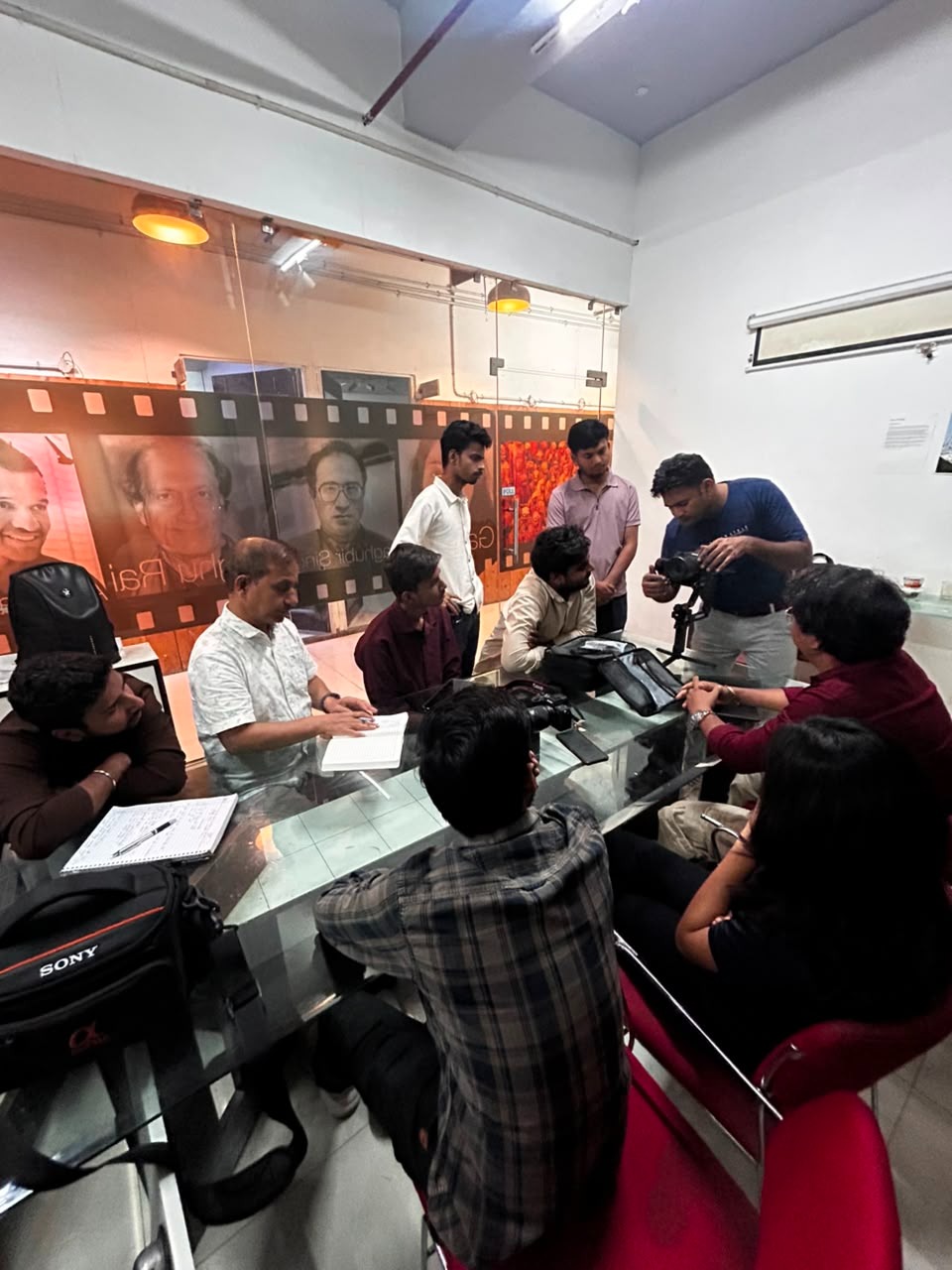
India is not merely consuming visual content - it is learning to create it. From the boardrooms of global brands to the campuses of Tier-II cities, visual storytelling has quietly transformed from an artistic hobby into one of the most consequential professional skills of our time. And for students asking what after 12th?, the answer increasingly begins behind a lens.
The Economy That Runs on Images
A photograph has never been just a photograph. It is an argument, a memory, a persuasion tool, a cultural document. What has changed is the scale at which images now shape commerce, policy, and identity - and the speed at which that demand has grown.
The global photography services market, valued at USD 37.51 billion in 2025, is forecast to cross USD 48.91 billion by 2031. Asia-Pacific is the fastest-growing region, expanding at a projected 6.19% CAGR. Closer to home, India's media and entertainment sector reached approximately ₹2.5 trillion in 2024 and is projected to cross ₹3 trillion by 2027. Behind these numbers lies a simple structural reality: every brand, every government initiative, every OTT platform, every election campaign, every NGO - all of them need people who can tell stories with images.
The Orange Economy and India's Creative Moment
India is now openly betting on what economists call the Orange Economy - industries that derive their value from human creativity, intellectual property, and cultural expression. The Union Budget 2026-27 and the Economic Survey 2025-26 both place this sector at the centre of India's employment and export strategy.
Photography is not peripheral to this moment - it is foundational to it. Every piece of visual content, from a brand film to a documentary to a news photograph to a fashion campaign, begins with someone who understands light, composition, and narrative. The photographer-as-storyteller sits at the origin of the Orange Economy's value chain.
What the Market Actually Needs
The photography career in India has expanded far beyond the traditional studio portrait or wedding assignment. Today's visual storyteller may work as a brand photographer, a cinematographer, a documentary filmmaker, a photo journalist, a social media content director, a fine art practitioner, or a cultural documentarian. The distinctions matter less than the underlying ability: to see the world with trained eyes and translate that vision into images that communicate.
Corporate marketing budgets globally have increased visual content allocation by 23% since 2023. As businesses prioritize visual storytelling and corporate branding, demand has grown sharply for photographers skilled in event coverage, corporate portraiture, and brand photography. In India specifically, the rise of OTT platforms, D2C brands, the creator economy, and government-led cultural initiatives has opened career verticals that simply did not exist a decade ago.
- Brand & Advertising Photography - for agencies, D2C brands, fashion labels.
- Documentary & Photojournalism - for news organisations, NGOs, and government bodies.
- Film & Cinematography - scripted, unscripted, OTT, corporate.
- Fine Art Photography - exhibitions, galleries, international residencies
- Cultural Documentation - archival projects, heritage bodies, academic institutions.
- Content Creation - platforms, personal brand, influencer economy.
- Photography Education - teaching, workshops, institutional faculty.
A Success Story Rooted in Conviction
Before the Orange Economy had a name, before the WAVES Summit had a stage, before any government policy recognised creative arts as a career pathway - IIP Academy was building the infrastructure for exactly this moment.
Founded by Rajesh Goyal in 2009, IIP Academy was among the first institutions in India to establish that photography could and should be taught as a rigorous professional discipline, not merely as a hobby or a technical skill. Over 33,000 students from more than 40 countries have trained at the academy across its 16-plus years of operation. Many have gone on to work with National Geographic, Google, Mercedes, The Times of India, and major advertising agencies across the world. The 100% placement record the institution maintains is not a claim made in the abstract - it is the outcome of a deliberate, decade-long alignment between curriculum, mentorship, and industry.
Photography education in India is no longer about teaching someone to press a shutter. It is about producing visual thinkers - people who can read a culture, translate it into images, and contribute those images to the world. At IIP Academy, we have always believed that the student who graduates with a camera should graduate with a career. The nation's creative economy is now catching up to what we knew all along: that creativity, when developed with rigour and purpose, is the most employable skill of this century. - Rajesh Goyal, Founder & Chairman, IIP Foundation & IIP Academy
Structured Education: Why It Changes Everything
The difference between someone who takes photographs and someone who builds a career in photography is almost never about talent alone. It is about structured learning, mentored practice, industry exposure, and the credential that formal education provides. This distinction becomes decisive the moment a student enters the professional world.
IIP Academy's programmes - spanning from a Diploma in Fine Arts Photography through to a Bachelor of Fine Arts in Photography or Film Making and a Master of Fine Arts in Photography - are built around this conviction. The Guru-Shishya model that the institution follows is not a nostalgic gesture; it is a pedagogical strategy that creates close mentorship, small batch sizes, and continuous formative feedback. Every programme is anchored in practical, project-based learning with real industry assignments woven throughout the curriculum.
The result is graduates who are not looking for their footing when they enter the industry. They arrive with portfolios, professional relationships, and the confidence of having already worked under conditions that approximate their eventual careers.
The Academic Collaboration That Is Changing the Map
For students choosing a photography career in India, the question of degree credentialing used to present a dilemma: either pursue a conventional fine arts degree at a general university with minimal photography specialisation, or attend a specialist institute without formal degree status. That dilemma no longer exists in North India.
The academic collaboration between IIP Academy and Bareilly International University (BIU) created, for the first time in North India, university-level degree programmes in Photography and Film Making aligned with NEP 2020. The Faculty of Fine Arts at BIU now offers BFA in Photography, BFA in Film Making, MFA in Photography, Diploma in Photography, and Diploma in Cinematography - all delivered through the IIP Academy model of mentorship and practical training, all carrying UGC-recognised degrees from a formally established university.
Building the Nalanda of Creative Arts
The long-term vision that animates this collaboration is explicitly civilisational. IIP Foundation's founding aspiration - to build an Institute of National Importance in Cultural and Creative Arts, in the spirit of Nalanda and Takshashila - is now finding its institutional expression through the Faculty of Fine Arts at BIU. A centre of creative learning rooted in Indian culture, connected to global industries, and positioned in the heart of North India: this is not merely an admissions proposition. It is a statement about what education in the Orange Economy era must look like.
Creative Careers After 12th: The Practical Picture
For students in and around Delhi NCR - in Bareilly, Noida, Meerut, Lucknow, Agra, and the broader Uttar Pradesh belt - the practical question is where to find rigorous photography education without relocating to a metropolitan city and paying metropolitan costs. IIP Academy's dual-campus presence in Noida and Bareilly makes it one of the most accessible options for Photography Courses Near Delhi NCR that offer formal degree pathways.
Programmes begin with a pre-registration process and proceed through an entrance test and interview with the Academic Board. This is not a barrier for its own sake - it is the institution's way of ensuring that every student who enters is serious about the commitment, and that every batch is a cohort of genuinely motivated practitioners. Twelve seats per batch is a deliberate choice: intimate enough for real mentorship, rigorous enough to mean something.
The academic calendar runs from 17 August, with all three degree programmes delivered as full-time, on-campus regular programmes. Students based in the NCR region benefit from proximity to Noida for advanced training and industry exposure, while the primary academic campus on the BIU grounds in Bareilly provides a structured, immersive learning environment away from the noise of metropolitan distraction.
The Image India Needs to Make
At the inaugural WAVES Summit in Mumbai, Prime Minister Narendra Modi articulated what many in the creative education space have long understood: This is the right time for 'create in India, create for the world. The creative economy is not a niche supplement to India's growth story. It is one of its central chapters.
Visual storytelling sits at the heart of that chapter. India has the cultural depth, the demographic dividend, and the growing institutional infrastructure to become a genuine global hub for creative content. What it needs - what every ambitious economy in this transition needs - is the trained human capital to realise that potential. Schools of art, institutions of photography education, and academic collaborations like the one between IIP Academy and Bareilly International University are not peripheral to that project. They are the project.
A student who enrolls today in a structured photography programme is not merely choosing a career. They are choosing to be part of a national creative movement that is only beginning to understand its own scale. The India that tells its own stories, in its own visual language, to a global audience - that India is being built, one graduating cohort at a time.
