
Why Brands Are Hiring Visual Storytellers Instead of Just Photographers – The IIP Academy Approach

The camera is no longer enough. Brands today don't just want someone who can operate one. They want a professional who can think in narratives, build emotional arcs through images, and translate a company's identity into visual language that stops a scroll, sells a product, or documents a culture. This shift has made visual storytelling one of the most sought-after skills in the creative economy - and it's changing what it means to study photography.
The Difference Between a Photographer and a Visual Storyteller
For a long time, the job description was simple: show up, shoot, deliver. A photographer captured what existed. That was enough.
It isn't anymore.
A visual storyteller does something harder. They arrive with intent - a conceptual framework, a narrative architecture, an understanding of who the audience is and what emotion the image must land. The photograph is the output. But the thinking that produces it comes from somewhere much deeper than technical training.
This distinction matters enormously in the industry right now. Brands like National Geographic, Google, Mercedes-Benz, and Harley-Davidson - organizations that IIP Academy graduates have worked with directly - aren't commissioning images. They're commissioning meaning. They need professionals who understand photography and visual storytelling as inseparable disciplines.
What's Driving This Shift in the Industry
The global photographic services market was valued at USD 37.96 billion in 2025 and is projected to grow to approximately USD 66.8 billion by 2035, expanding at a CAGR of 5.81%. That growth is not coming from portrait studios or wedding albums. It is being driven by digital marketing, social media campaigns, and the intensifying need for professional visual storytelling across industries.
These aren't opportunities for generalists. They are openings for trained, credentialed, conceptually rigorous visual professionals - the kind that a structured visual storytelling course at degree level is built to produce.
Why Technical Skill Alone Is No Longer Enough
Here is the problem that most self-taught photographers run into: they can produce technically correct images, but they cannot command a creative brief, build a campaign, or direct a shoot with artistic authority.
Brands have learned to tell the difference. Corporate clients, media houses, and OTT platforms don't brief a photographer the way they once did. They brief a creative director, a content strategist, a visual communicator - and they expect the person holding the camera to be all three.
This is exactly the gap that a Bachelor in Fine Arts Photography programme is designed to close.
A BFA isn't just a photography course with a degree attached to it. It is four years of structured exposure to art history, visual culture, light theory, composition, conceptual thinking, cultural documentation, post-production, and professional practice. A graduate emerges not merely as a certified photographer in the technical sense, but as an artist who understands why images work - and how to make them work with purpose.
How IIP Academy Builds Visual Storytellers
IIP Academy - operating under the Faculty of Fine Arts in collaboration with Bareilly International University, UGC-recognised and aligned with NEP 2020 - has been working on this problem for over 16 years.
The institution has trained more than 33,000 students from over 40 countries. Its graduates carry a 100% placement record. But what makes that record possible isn't a placement cell - it's a pedagogy designed from the ground up for industry relevance.
The Guru-Shishya Learning Model
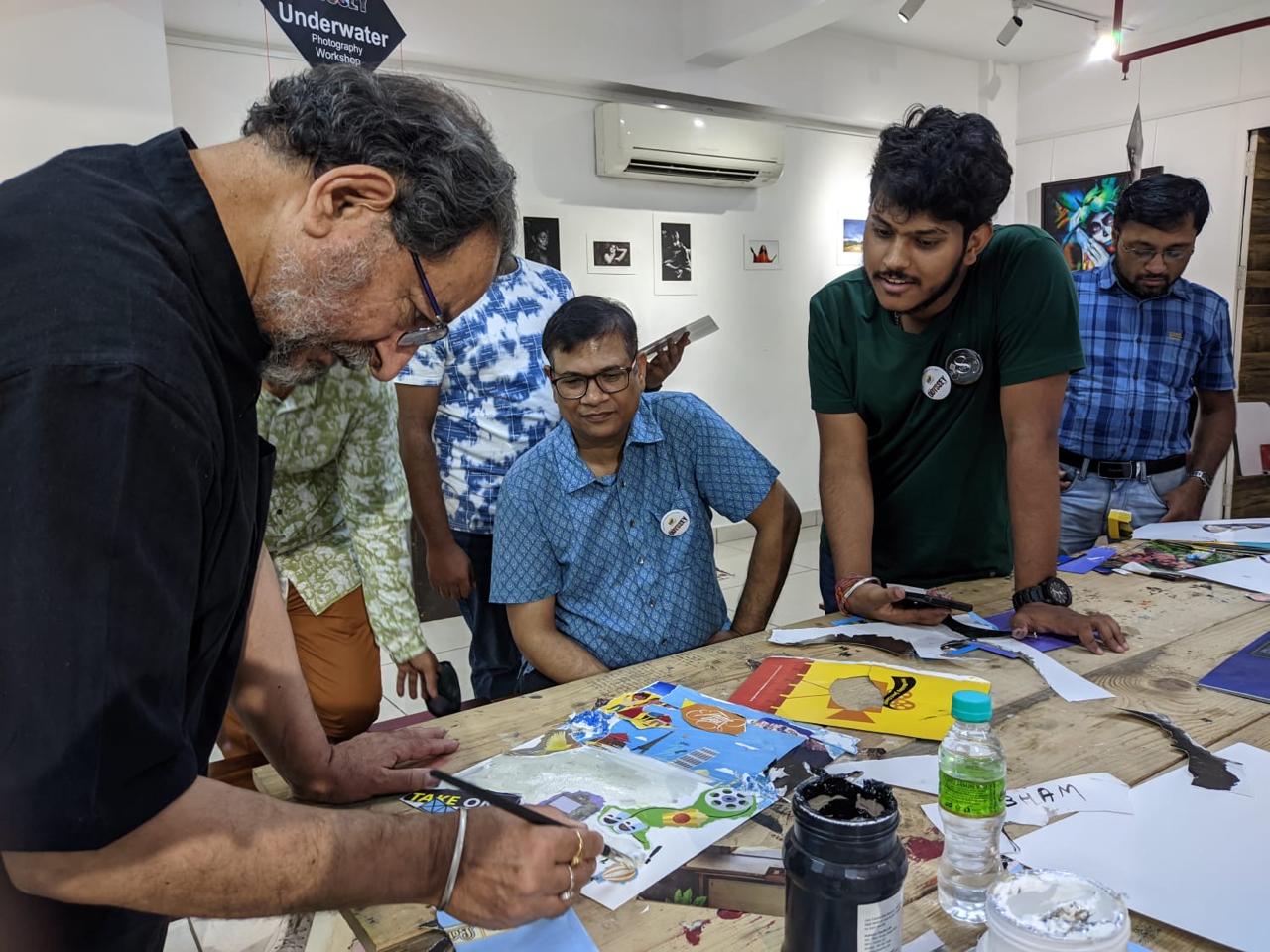
At IIP Academy, mentorship is structural, not incidental. Learning happens in small groups guided by working professionals - photographers, filmmakers, and visual artists with active careers. This is not the lecture-hall model. It is the atelier model: practitioner-led, project-driven, and built around real creative problems.
Students work on live assignments for media houses, NGOs, cultural organizations, and government events. By the time they graduate, they have a portfolio that looks like it belongs to a working professional - because it was built through the work of one.
Project-Based Learning from Day One
From their first semester, students are assigned documentary projects, cultural documentation shoots, commercial briefs, and conceptual series. They learn to receive a brief, develop a visual concept, execute it under pressure, and present it for critique.
This is precisely what a visual storytelling course must deliver: not theory about narrative, but the muscle memory of building one - assignment after assignment, semester after semester.
Cultural Grounding as Creative Capital
IIP Academy's curriculum integrates India's visual and cultural heritage as source material for contemporary practice. Students document traditions, crafts, rituals, and landscapes - not as archivists, but as artists who understand how cultural depth translates into powerful imagery.
This grounds the work in something authentic. In an era when clients are saturated with stock images and AI-generated content, photographs that carry genuine cultural intelligence are genuinely rare - and genuinely valued.
The Programmes: Built for the Industry's Actual Needs
IIP Academy's Faculty of Fine Arts offers a range of programmes aligned with where the industry is heading:
- BFA in Photography - 4-year Honours programme; 3-year track also available. Covers commercial, documentary, fine art, and conceptual photography with deep art education.
- BFA in Film Making - 4-year Honours programme; for students drawn to moving image, cinematography, and screen storytelling.
- MFA in Photography - 2-year postgraduate programme, open to graduates from any stream. 1-year accelerated track for BFA Honours graduates.
- Diploma in Photography / Cinematography - 2-year structured programmes for students looking to build professional skills with academic grounding.
All programmes require an entrance test and interview with the Academic Board - a selection process that ensures each cohort is built for serious creative education, not mass enrollment.
As a leading photography institute in India affiliated with a UGC-recognised university, IIP Academy's degrees carry the weight of formal academic recognition combined with the depth of specialist creative training.
What Certified Means in 2026
The word certified has been diluted by the proliferation of short online courses and weekend workshops. A student completing a two-hour module and receiving a PDF certificate is not the same as a graduate who has spent four years inside a rigorous academic and creative programme.
When brands, editorial houses, film productions, and cultural institutions hire certified photographers, they are increasingly looking for professionals whose credentials signal more than a completed checklist. They want evidence of sustained creative development, critical thinking, professional conduct, and portfolio depth.
A BFA in Photography from IIP Academy - conferred through Bareilly International University under the Faculty of Fine Arts - is that evidence. It signals that the graduate has been tested: by faculty, by clients, by cultural encounters, by public critique. That is what a degree-level creative education is for.
The Career Landscape That Awaits
Graduates trained as visual storytellers have a far wider career map than those trained solely as camera operators. The roles that IIP Academy alumni have entered include:
- Commercial and advertising photographers for national and international brands
- Documentary photographers for NGOs, government agencies, and media houses
- Content strategists and visual directors for digital brands
- Cinematographers and directors of photography for film, OTT, and corporate production
- Fine art photographers and exhibiting artists
- Cultural documentarians working with heritage organizations
- Photography educators and workshop facilitators
- Entrepreneurs running studios, production houses, and visual content agencies
The AVGC sector alone, as noted, is projected to require two million skilled professionals by 2030. This is not a niche opportunity. It is a structural shift in India's economy - and the trained visual storyteller is positioned at the centre of it.
A Final Thought
The question of whether to study photography seriously - as a degree, as a discipline, as a four-year investment - often gets framed as a question about risk. Is there a market? Will there be jobs?
The data says yes, emphatically. The global photography services market is growing. India's creative economy is expanding faster than most sectors. The government is investing in creative infrastructure at a scale not seen before.
But the more precise question is: will there be jobs for you, specifically?
That depends on whether you enter the market as someone who can press a button - or as someone who can tell a story. IIP Academy exists to produce the second kind.
